begin show
and the show
Illness Can't Bind
Artist's Spirit
thumbnail index
for show
other thumbnails
about this site
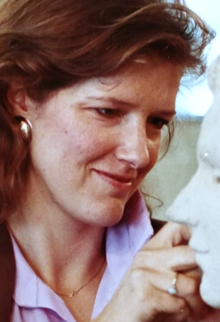
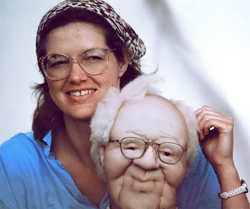
These are the bio, artist’s statement, acknowledgements, and technical notes Gay wrote for the show, followed by some additional background.
Bio
- Born in 1956
- B.S. from Utah State University, Art Education
- M.A. from Brigham Young University, Art Education
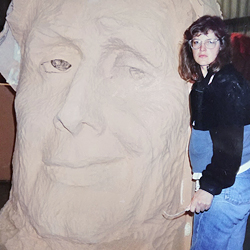
- Put herself through graduate school making life‑sized soft sculptures (one old couple now resides in the LDS Church History Museum)
- Travelled in Europe, Russia and Scandinavia
- Conducted art workshops for teachers in Newfoundland, Canada
- Tried to avoid winter by living in Mexico for three months
- Worked in film industry for 12 years as an artist and set decorator. Films range from Halloween IV to Legacy and include Overboard, A Midnight Clear, A Walk In The Clouds and Honey I Blew up the Kid
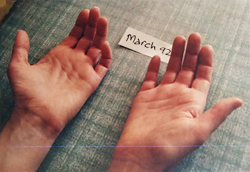
- Diagnosed in 1991 with Motor Neuron Disease, which is a form of Muscular Dystrophy similar to Lou Gehrig's Disease
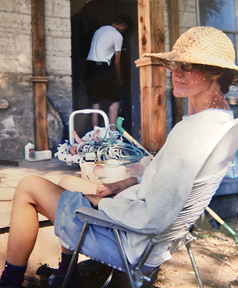
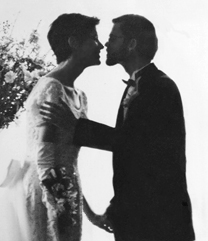
- Now lives in Mt. Pleasant with her husband, Kent Appleberry, whom she married in 1996. Oversaw restoration of 130‑year old house in which she lives
- Currently involved in designing web pages for Sanpete.com and creating art prints using computer technology
Gay died at home on September 11, 2000 (the year before that other September 11th).
Artist’s statement
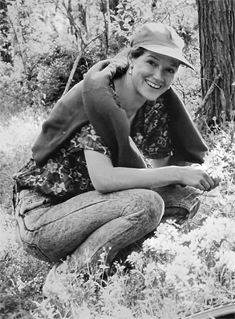
As my disability has progressed, it has affected my commitment to artwork, the material process of my art, and my subject matter. I always felt I should do artwork, but I rarely stopped to do it. I was too busy. Now that I've lost the ability to do most physical things, one of the few options I have left for engaging myself constructively is to create art. It's a paradox that the less easily I can do it the more I am driven to it as an avenue of expression. Although I’m still annoyed about being disabled, it has made me do things I might not have done otherwise.
I always preferred sculpture and printmaking because of the way those processes and their materials lend their own definition to a piece. I enjoyed the random qualities they brought to my work. Since I can no longer use traditional tools, I now use a computer to create prints. This allows an extreme amount of control in some ways, right down to the pixel, and eliminates many of the accidental results that I liked. However, I now have a pretty wild hand on the mouse, which introduces plenty of unpredictability, and the complex programs I use sometimes surprise me too. Some doors have closed while others have opened.
In college I thought that there must be some great cosmic meaning to art. Now I gravitate towards my childhood approach, which is simply to draw. The result is a mix of humor, banality, and expression of deeper feelings. Although my disability affects the tools I use, there is continuity in my subjects. I always tended to draw people more often than things, and women more often than men. My women have tended to be plump and voluptuous and full of feeling. I still like drawing large women and, stuck now in this skinny body, long for fatness. However, I've also begun to make images which explore my extreme thinness. Drawing my own body somehow reacquaints me with it in its new state. It also helps me see it as more beautiful.
Acknowledgments
Heartfelt thanks to Susan Valentine, who nudged me into this project, and provided much encouragement and hard work, along with frequent lodging. She also was my hand in writing the titles on the prints. To Debbie Drennan [Bennett], who helped me with her time, equipment and expertise in preparing the images for printing. To Sue [Valentine, Susan's mother] and Stephany [Valentine Cook] at Apple Yard Art for their help in framing and packaging. To my husband Kent Appleberry for nagging me the past nine months to get this done, and for his continual care. And to Judy & Doug Payne for putting us up and putting up with us, Dylan Payne for giving up his room, and to Roger Crandall, Christy Johansen, Daniel Graziano, Elaine Jarvik, Tom Smart, Dottie Miles, Harmony [Lauritzen-Brown], Steve Beal at Interwest Rastar, and Ruth [Lubbers] and Vonnie [Wildfoerster] at Art Access for things too numerous to mention.
Technical notes
The technical process wasn't as intuitive to most people then as it might be now. Digital photography wasn't yet common, most people had never created or processed an image digitally, so Gay's explanation includes the most basic points.
I use a professional graphics program called Adobe Photoshop. The drawings are created by using a computer mouse much as one would use a brush or pen. Movements of the mouse are translated into corresponding lines and marks on a computer screen. The program allows me to chose textures similar to those of brushes, pens, pencils, and other standard art tools. Colors can be chosen and altered in a variety of ways, by numeric proportion of basic colors (similar to mixing pigments), by adjusting hue on a continuous scale (similar to adjusting your TV set’s color), by adjusting saturation and value (more color/less color, lighter/darker), and so on. There are many ways to edit an image, as it were, including copying or deleting parts of it, moving parts, and superimposing.
One of the nicest features is that you can save a copy of your piece, and then if you do something ruinous to it, you can always get back the earlier version. This encourages experimentation.
Once the image is complete on the computer, the digital file is taken to the print shop. The images are printed using a professional Iris printer, which can produce a continuous tone rather than a pixelated dot pattern. We use archival quality Equipoise inks on Somerset paper, which is cold pressed, 100% cotton, 500 grams per sheet (168 pounds per hundred sheets).
Additional background
Photoshop and other digital image editing and design programs were of mainly commercial or hobby use back when, not usually regarded as primary media for "real art" in art galleries. Gay didn't have much choice which media to use, she could no longer control physical brushes and pencils.
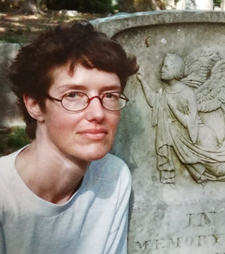
She introduced herself to digital art in September 1995 with Dabbler 2.0, a beginner's program. She got it and Photoshop through the vocational rehab office she had been working with. She doesn't seem to have done anything serious with it at the time, only explored a little.
In November of 1996 she returned to it, intending to complete a project she had begun in physical media: illustrations for a Nativity-themed Christmas counting book for children, with text by her sister-in-law's sister Lisa Madsen de Rubilar. She didn't complete any pieces for it digitally. The first digital piece she definitely completed, apart from a doodle, may have been Christmas angel, an illustration for her 1996 Christmas mailing.
She did some other digital pieces about the same time, some that look complete or near enough, but none of the earliest pieces ended up in the show. Through the next couple years she started many other pieces in Dabbler, eight of which she did put in the show.
In 1999 she gave Photoshop a serious try. It's a much more complex and capable program with a steeper learning curve. Mostly by experimentation, she figured out the layers system and how to get the results she wanted. All of the pieces in the show were processed in Photoshop to some extent, even those originally created in Dabbler.
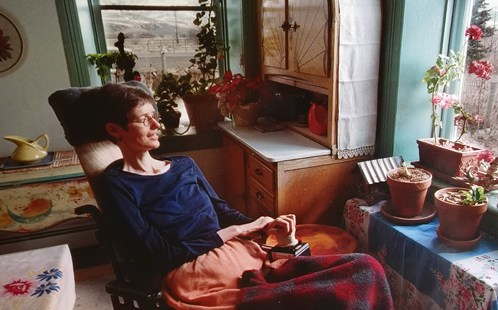
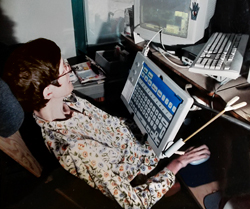
Gay's friend Susan Valentine was the instigator for the show, had the idea, got the process going, and did much to facilitate the work. She made the connection to what might have been the only gallery in the region that would welcome digitally-created work like this at the time, Art Access, dedicated to artists with disabilities or other barriers.
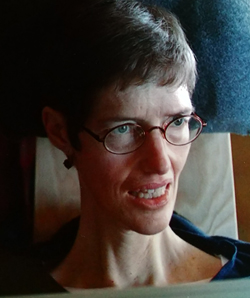
Gay often had second, third and nth thoughts about a piece, trying different colors and backgrounds, redrawing parts, and so on. Only the hard deadline of the show ended that. It also provided additional motivation. She had complained about lack of motivation to do her own artwork even when healthy, even though she enjoyed it. She said it had always been easier to complete art projects required for school or work. The show was a reason for by far her most productive period as an artist.
It was a success in other ways too. It got unusually great media coverage and sold a lot of prints. And now it has a website.
Something to share? It will be added here (eventually, have to screen for spam). All fields are required to post the comment.
- entrance
- begin show
- about the artist and the show
- Woman Falling
- Illness Can't Bind Artist's Spirit
- thumbnail index for show
- other thumbnails
- about this site